

In our rapidly evolving world of artificial intelligence, remote collaboration, and constant technological disruption,
the way we approach challenges can determine whether we thrive or merely survive. The growth mindset offers
a transformative framework for personal and professional success.
Popularised by Stanford psychologist Carol Dweck, this concept emphasises that abilities and intelligence are
not fixed but can be developed through dedication, effort, and learning from setbacks.
Adopting a growth mindset helps individuals view obstacles as opportunities rather than threats. It fosters
resilience, encourages continuous improvement, and ultimately leads to higher achievement across all areas of
life.
Whether you are a student preparing for exams, a professional navigating career changes, or a parent
supporting your child’s development, cultivating a growth mindset can revolutionise your trajectory. This in-depth
guide explores the foundations, benefits, practical strategies, and real-world applications of the growth mindset,
providing actionable insights to help you begin your journey today.
What is a Growth Mindset?
At its core, a growth mindset is the belief that your qualities – such as intelligence, talent, and character – can be
cultivated through hard work, good strategies, and input from others. People with this outlook understand that
failure is not a reflection of their inherent worth but a natural part of the learning process. They embrace challenges,
persist despite obstacles, and see effort as the path to mastery.
Carol Dweck’s extensive research, spanning decades, reveals how this simple shift in perspective dramatically
influences outcomes. In her seminal book Mindset: The New Psychology of Success, she explains that individuals
operate on a spectrum between two mindsets. Those leaning towards growth consistently outperform their
fixed-mindset counterparts because they focus on development rather than validation of existing abilities.
This approach encourages a love of learning for its own sake. Instead of asking “Am I good enough?”, growth –
oriented thinkers ask “What can I learn from this?” In 2026, with AI tools reshaping industries, this adaptability has
never been more vital.
Growth Mindset Versus Fixed Mindset:
Understanding the Crucial Differences
To truly grasp the power of a growth mindset, it is essential to compare it with the fixed mindset. A fixed mindset
assumes that abilities are static – you are either naturally talented or you are not. This often leads to avoiding risks,
giving up quickly, and feeling threatened by others’ success.
In contrast, a growth mindset views every experience as a chance to expand capabilities. Challenges become exciting,
criticism becomes constructive, and setbacks fuel determination.

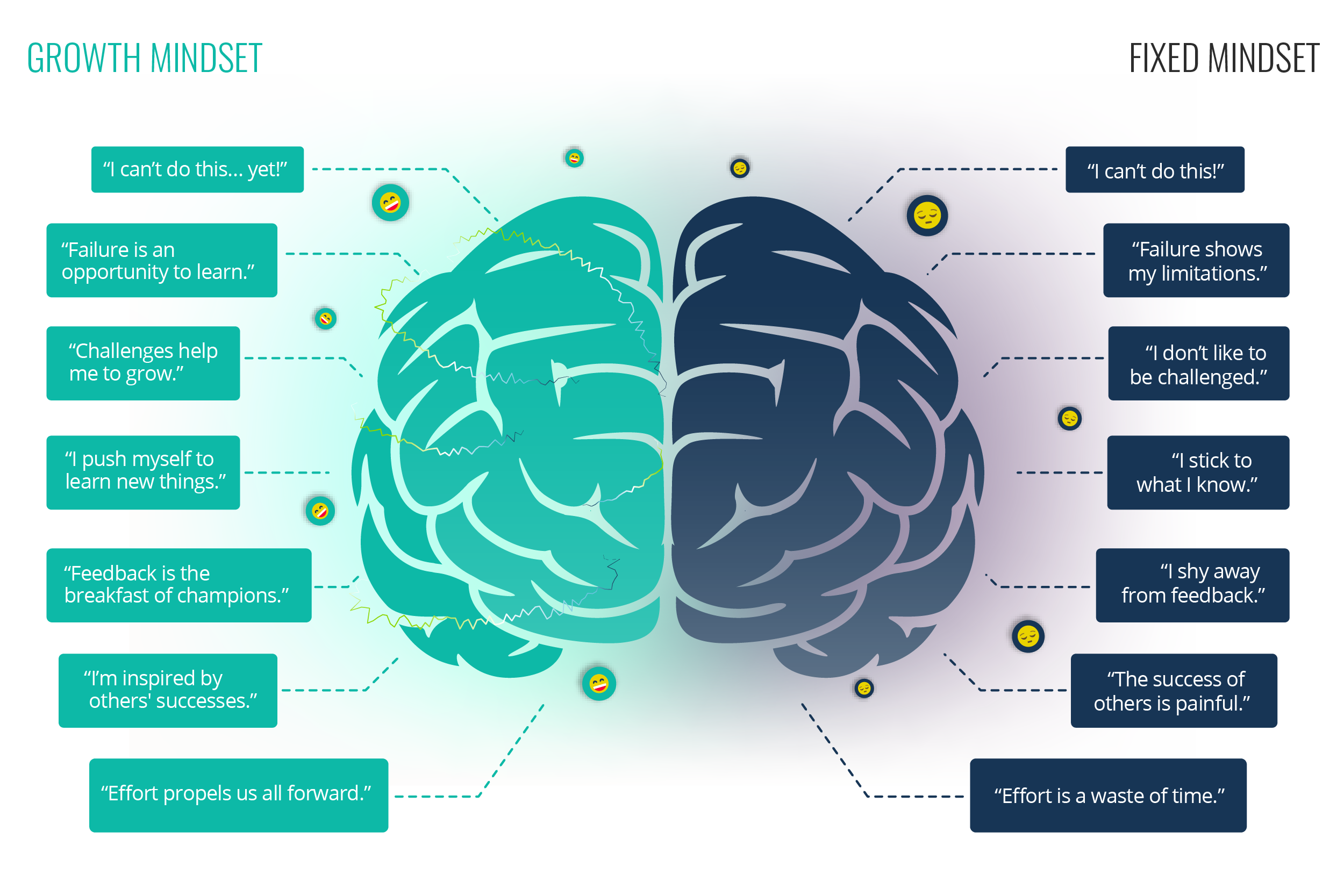
The visual contrasts above highlight these differences clearly. On one side, statements like “I can’t do this… yet!” represent
growth thinking, while “I can’t do this!” reflects a fixed outlook. Research consistently shows that shifting from fixed to growth
language improves performance, motivation, and emotional wellbeing.
Recognising your current tendencies is the first step. Many people exhibit a mix of both mindsets depending on the situation
– perhaps growth-oriented in sports but fixed when it comes to public speaking. The good news is that mindsets are malleable;
with conscious effort, anyone can move further towards growth.
The Science-Backed Benefits of a
Growth Mindset
Extensive studies, including those conducted by Dweck and her colleagues, demonstrate profound advantages for those who
cultivate a growth mindset. Students with this perspective achieve better academic results because they persist through
difficulties and seek help when needed.
In professional settings, employees display greater innovation, collaboration, and adaptability – essential qualities amid 2026’s
hybrid work environments and AI integration.
Key benefits include:
- Enhanced resilience: Setbacks are reframed as temporary and informative
rather than defining.
- Enhanced resilience: Setbacks are reframed as temporary and informative
- Increased motivation: Effort becomes rewarding, leading to sustained
engagement.
- Increased motivation: Effort becomes rewarding, leading to sustained
- Improved relationships: Constructive feedback strengthens connections
instead of causing defensiveness.
- Improved relationships: Constructive feedback strengthens connections
- Greater overall achievement: Long-term goals become attainable through
consistent practice.
- Greater overall achievement: Long-term goals become attainable through
In education, teachers who promote growth principles see higher engagement and reduced anxiety among pupils. In business,
leaders fostering this culture report lower turnover and higher creativity. Even in personal health and fitness, viewing
improvement as a process rather than an innate trait leads to better adherence to exercise routines and dietary changes.
How to Develop a Growth Mindset:
Practical Strategies for Everyday Life
Developing a growth mindset requires consistent practice, but the rewards are life-changing. Here are proven, actionable steps
to cultivate this powerful outlook.
Embrace Challenges as Opportunities for Growth
Rather than avoiding difficult tasks, actively seek them out. When faced with a complex project at work or a new skill to learn,
remind yourself that discomfort signals growth. Start small – perhaps by trying a new recipe or enrolling in an online course on
a topic outside your comfort zone. Over time, this builds confidence and expands your capabilities.
Learn from Feedback and Criticism
View constructive criticism as a gift rather than a personal attack. After receiving feedback, ask yourself: “What can I improve
next time?” In professional environments, this behaviour leads to faster career progression. Practise by requesting regular input
from mentors or colleagues and reflecting on it without defensiveness.

Focus on Effort and Process, Not Just Outcomes
Celebrate the journey, not only the destination. Praise yourself for the hours spent practising rather than solely for the final result.
Parents and educators can apply this by saying “I’m proud of how hard you worked” instead of “You’re so clever.” This subtle shift
encourages persistence and reduces fear of failure.
Cultivate Curiosity and Commit to Lifelong Learning
Maintain an open, inquisitive approach to the world. Read widely, ask questions, and experiment with new ideas. In 2026,
platforms offering micro-credentials and AI-powered learning make continuous development more accessible than ever.
Set aside time each week for deliberate practice in an area you wish to improve.
Replace Negative Self-Talk with Growth-Oriented Language
Monitor your internal dialogue. Swap “I’m not good at this” with “I’m not good at this yet.” This small linguistic change,
backed by psychological research, rewires neural pathways over time and boosts confidence.

Real-World Examples of
Growth Mindset in Action
History and contemporary life are filled with inspiring stories. Michael Jordan, widely regarded as one of the greatest
basketball players, was cut from his high school team yet used that rejection as fuel to train harder. Thomas Edison
famously reframed thousands of unsuccessful attempts at inventing the lightbulb as steps towards success.
In modern contexts, entrepreneurs like those building AI startups in 2026 often credit their growth mindset for
navigating funding rejections and pivots. Athletes in the Olympics frequently speak of viewing losses as valuable data
points. Even everyday heroes – teachers who return to study new methodologies or parents learning digital skills to
support their children – demonstrate the mindset daily.
Overcoming Common Obstacles
When Building a Growth Mindset
Transitioning is not always straightforward. Societal emphasis on natural talent, fear of judgement, or past experiences
of harsh criticism can reinforce fixed thinking. To overcome these, start with self-awareness: keep a journal noting
instances where you default to fixed language. Surround yourself with growth-oriented individuals and consume content
that reinforces positive messages, such as podcasts featuring Dweck or motivational literature.
Patience is key – mindset shifts occur gradually through repeated small actions.
Integrating a Growth Mindset into
Education, Work, and Daily Life
In schools, teachers can praise process and encourage reflection on mistakes. In organisations, leaders should model
vulnerability by sharing their own learning journeys and reward experimentation. At home, families can establish routines
like weekly “growth discussions” where members share what they learned from challenges.
In the digital age of 2026, tools such as AI coaches and progress-tracking apps make maintaining this mindset easier.
The key is consistency across contexts.
Conclusion: Start Cultivating Your
Growth Mindset Today
The growth mindset is more than a psychological concept – it is a practical philosophy for living a fuller, more accomplished
life. By understanding the differences from a fixed outlook, recognising its science-backed benefits, and implementing daily
strategies, you position yourself for continuous improvement and greater fulfilment.
Begin with one small change this week: reframe a current challenge as a learning opportunity or replace a self-limiting
thought with growth language. Reflect regularly on your progress. Over time, you will notice increased resilience, heightened
motivation, and exciting new possibilities unfolding.
Embrace the journey of growth. Your potential is not predetermined – it is waiting to be developed. What step will you take
first towards cultivating your growth mindset? Share your thoughts in the comments below and inspire others on their path
to success.